When I was a child, my grandmother’s house in Montego Bay always felt full.
Not lively exactly. Just full.
Full of people, tension, routines, grief, silence, church clothes hanging to dry, pots boiling on the stove, and emotions I didn’t yet understand. Multiple generations lived there at different points: my grandmother, my great-grandmother, my auntie, my uncle, and eventually me whenever my mother sent me “to country” after another explosion in Kingston.
As a child, I thought adults naturally understood one another.
As an adult, I realize most of them were wounded people orbiting each other in survival mode.
My auntie was my grandmother’s favorite child. Everybody knew it. Even as children, we knew which child held the emotional center of the household.
But what confused me was how badly she treated her.
She was sharp-tongued, impatient, and intimidating. I was honestly a little afraid of her growing up. She could make a room feel tense without even raising her voice. And despite being the favorite, she often spoke to my grandmother dismissively, the same way her other children did.
Back then, I didn’t understand where that behavior came from.
Years later, one of my cousins explained something that changed how I viewed the family entirely. She told me my mother and her siblings likely learned that behavior from watching their own father disrespect their mother openly while they were growing up.
And suddenly everything clicked.
Disrespect had been modeled long before I arrived.
Even my uncle’s relationship with my grandmother felt emotionally complicated in ways I couldn’t understand as a child. My grandfather had died before I was born, and over time, it seemed like my uncle quietly became “the man of the house.”
Every Sunday evening, my grandmother would carefully prepare him for the workweek ahead. She ironed his uniforms, polished his shoes, cooked his meals, and made sure everything was ready for Monday morning. He worked as a waiter in the tourist hotels and reportedly made very good tips, something I constantly heard about growing up.
Looking back now, I think my grandmother poured a tremendous amount of emotional energy into caring for him after losing her husband. At the time, I only knew it felt intense.
Then my auntie died.
She was only around thirty years old.
I remember the shock inside the house more than the sadness itself. The adults cried loudly. Grief became physical there. Heavy. Suffocating. Like it moved from room to room with its own body.
But if I’m being honest, I wasn’t devastated.
I was startled. Confused. Uneasy.
But there was also a small sense of relief inside me that frightened me to admit, even to myself. My auntie had scared me for years, and children don’t magically transform fear into reverence simply because someone dies.
That same year, my great-grandmother died too.
Oddly enough, I cried more for her than for my auntie, though not because I was deeply attached to her either. I cried because by then death itself terrified me. The atmosphere inside the house terrified me. The wailing. The mourning clothes. The heaviness. The way adults seemed to unravel emotionally in front of me.
And my grandmother noticed.
I remember her being upset that I cried for Granny but not for my auntie. I think she wanted me to feel what she felt. But children don’t always grieve symbolically. We grieve through experience, through safety, through fear, through whatever our nervous systems understand at the time.
After my auntie died, something in my grandmother changed permanently.
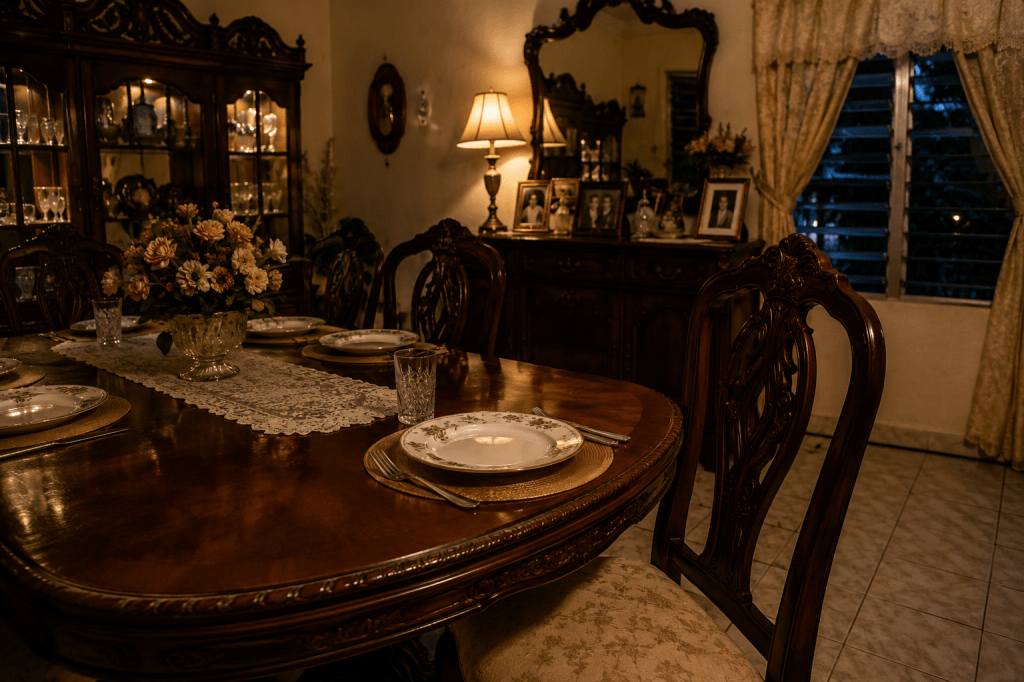
Every evening at dinner, she continued setting a place for her.
Not for a few days. Not for the funeral period.
For a long time.
A plate. A place setting. A seat waiting for someone who was no longer alive.
As a child, I didn’t know whether to find it sad or frightening.
One of my cousins eventually stopped visiting partly because the atmosphere disturbed her so much. Even as children, we could feel that grief had settled into the house and refused to leave.
Looking back now, I understand that my grandmother never truly recovered from losing her favorite child.
But I also understand something else.
Children observe emotional ecosystems long before they can explain them. We notice favoritism. Resentment. Fear. Grief. Dependency. The people everyone protects. The people everyone fears. The people who quietly hold a house together while breaking apart themselves.
At the time, I only knew Montego Bay felt safer than Kingston.
I didn’t yet understand that even safe houses can still be haunted.
More about life with Grandma in Tucker District, Montego Bay –>





Leave a Reply