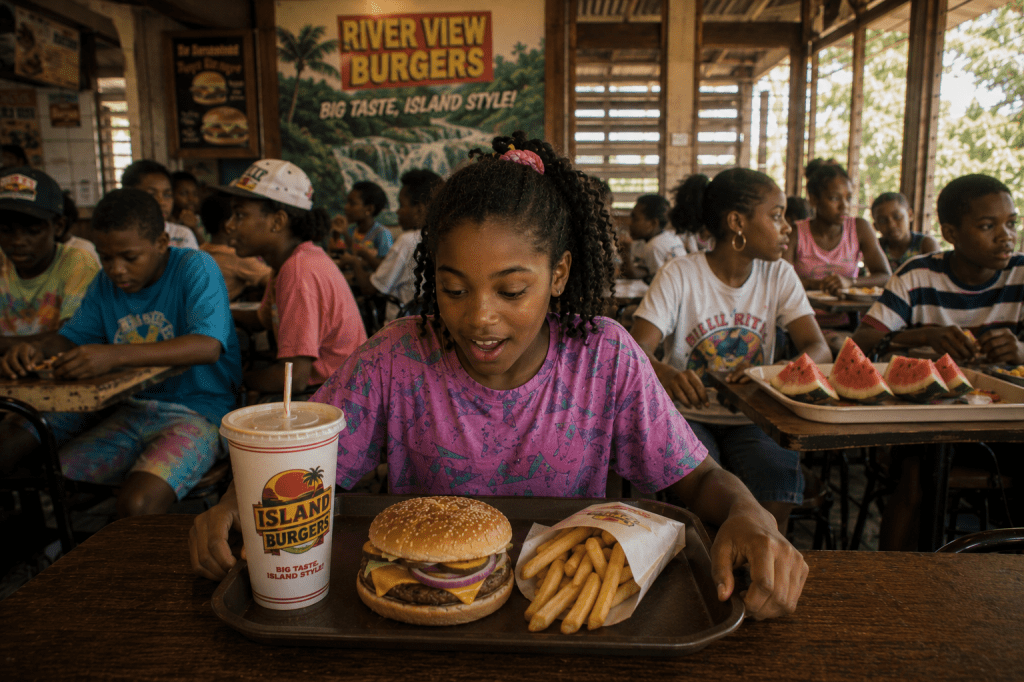
One of my favorite memories from Alvernia Preparatory School in Kingston, Jamaica happened during a class trip to Dunn’s River Falls in Ocho Rios.
At the time, class trips felt magical to me because I did not get to go out often.
People assume that because you live in Jamaica, you spend all your time at beaches and attractions. I didn’t. Going somewhere fun required coordination, money, transportation, and adults being emotionally stable enough to actually follow through with plans.
So a school trip felt enormous.
I remember being excited the entire morning.
But alongside the excitement, I also had anxiety about lunch money.
My father was paying for the trip, which already meant I knew money was being watched carefully. He was extremely strict about spending, and I was already aware that many of my classmates had far more financial freedom than I did.
I remember worrying beforehand about whether I would have enough money to participate when we stopped for food.
Back then, fast food in Jamaica was not casual for me. It was a treat.
And on class trips, children notice everything:
who orders freely,
who hesitates,
who counts bills carefully before stepping to the counter.
At some point during the trip, we stopped for lunch at a burger place. It was either Burger King or King Burger. I cannot remember the exact name now, but I remember clearly that it was a burger joint.
Normally, my father would have given me just enough money to buy something small.
But this time, something glorious happened.
The twenty-dollar bills stuck together.
Instead of receiving maybe forty dollars or so, I somehow ended up with about eighty dollars in my hand.
And suddenly, for one beautiful afternoon, I had rich kid money.
Not actual rich kid money, obviously.
But enough money to order without fear.
Enough money to buy a full meal:
a hamburger with pickles,
French fries,
and a drink.
To an American reader, that may not sound like much.
But to me, it felt enormous.
Then there was Renee.
Renee was a Haitian girl in my class. I remember her mother sent her on the trip with very little money and a giant watermelon for the class to share. The teacher presented the watermelon to us like it belonged to everyone. I did not understand at first that it came from Renee’s household or that eating some of it would somehow create an unspoken obligation.
So I ate some watermelon.
Later, Renee sat beside me and started making me feel guilty because I had eaten the watermelon while she had so little food money of her own.
I felt pressured.
So I gave her a small piece of my hamburger.
Not my fries.
Absolutely not my fries.
Even as a child, I had limits.
And I remember thinking, with all the righteous irritation a child can carry, that if I had known eating the watermelon meant I would have to trade away part of my miracle combo meal, I would have left that watermelon alone.
Looking back now, the whole memory makes me laugh.
But underneath the humor is something I understand much more clearly as an adult:
children become aware of class differences very early.
Not always through dramatic poverty.
Sometimes through small moments:
hesitating before ordering food,
counting lunch money,
pretending not to want things,
or feeling temporarily rich because a few bills accidentally stuck together.
That day at Dunn’s River Falls, I didn’t just enjoy a burger and fries.
I experienced what ease felt like, even if only for an afternoon.



Leave a Reply