Before I attended Alvernia Preparatory School in Kingston, Jamaica, I was enrolled at George Headley Primary School for about a year.
That school came through my father.
It was a public school, and while corporal punishment was heavily used there like in many Jamaican schools at the time, it was still considered a decent school academically and structurally. I made friends there. My half-brother attended too, which was unusual for us because we often ended up in different schools depending on who was paying and which side of the family was involved at the time.
In my family, education reflected hierarchy long before I understood the word hierarchy.
My younger full brother and I were usually the children sent to private schools whenever my parents could somehow manage it. My slightly older half-brother usually was not. Years later, my grandmother bluntly explained why. In her generation’s language, he was considered a “bastard child” because he was born outside of marriage.
I never saw him that way.
To me, he was just my brother.
But children notice unequal treatment long before they understand adult morality.
Eventually, my mother decided I needed to transfer schools again. One of her coworkers recommended Alvernia Preparatory School, and because my mother had attended Mount Alvernia High School in Montego Bay, she believed there was some connection between the schools. I think she imagined it as a pathway toward a prestigious high school education.
So after only one year, I was transferred again.
At that age, I had already learned not to become too attached anywhere.
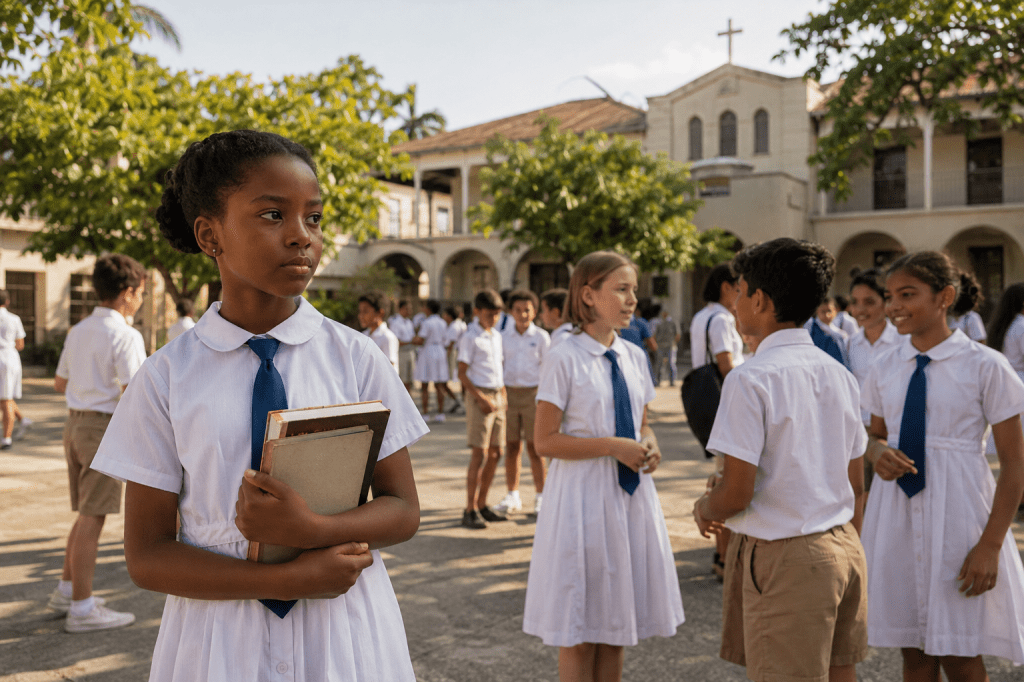
I still remember arriving at Alvernia for the first time. White uniform. Blue tie. Catholic atmosphere everywhere.
Up until then, I knew almost nothing about Catholicism.
The principal, Sister Alma Roberts, wore a full nun’s habit with the head covering and everything. As a child, what fascinated me most was the sore near her forehead or temple that never seemed to heal. It disturbed me so much that sometimes it reminded me of the wilted pastry edges on cafeteria patties, which unfortunately ruined my appetite whenever I looked at her too long.
Children are brutally honest observers.
The school itself felt completely different from any environment I had experienced before.
For the first time, I was surrounded by students from visibly different racial and cultural backgrounds all in one place. White students. Indian students. Asian students. Mixed-race students. Black students from different class backgrounds.
At first, it felt strange to me because I had not grown up in environments that looked that multicultural. But after a while, they simply became classmates in my mind.
What separated me more wasn’t race.
It was class and religion.
The priest visited regularly for services and communion, but only baptized Catholic students could participate fully. I couldn’t. My parents had never baptized me. None of us were particularly religious at home, despite sending us to Catholic school.
So I often felt like I was standing slightly outside of the experience everyone else seemed to understand naturally.
And economically, many of the students clearly lived very different lives from mine.
You could tell from the conversations, the extracurricular activities, the cars their parents drove, and the stories they casually told about home. Many had swimming pools, air conditioning, ballet lessons, karate classes, music lessons, tutoring, summer activities.
Their parents could comfortably afford the school plus the life surrounding the school.
For my family, tuition itself already stretched the limits.
All I really got to do was attend.


Leave a Reply