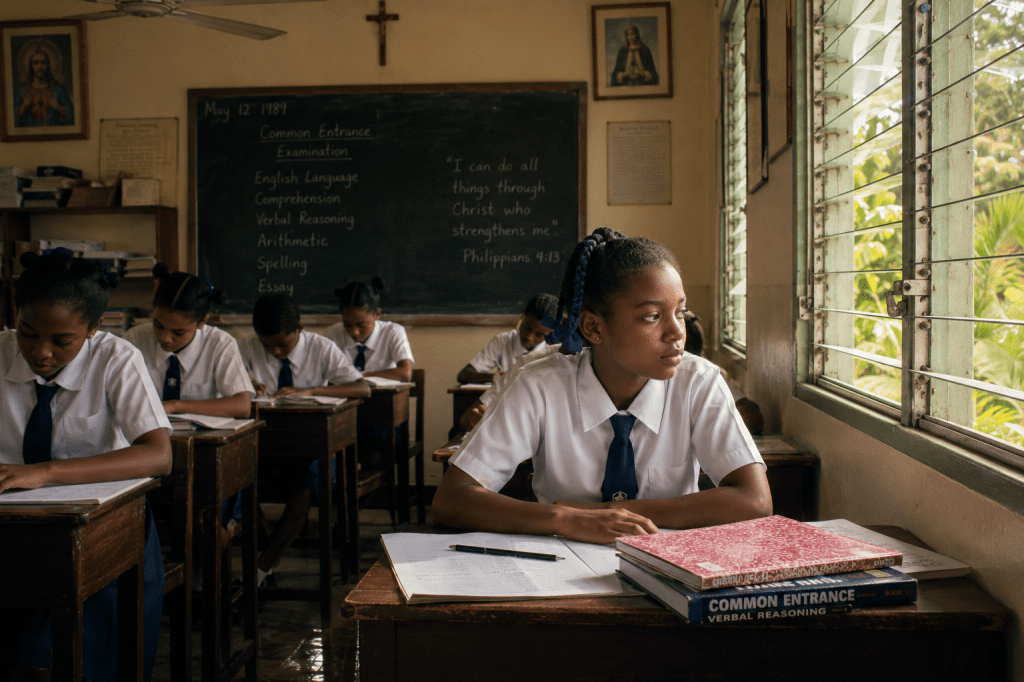
By the time common entrance season arrived at Alvernia Prep School, the anxiety around it was everywhere.
Even children who tried to act confident were nervous.
You could feel it in the classrooms, in the extra lessons, in the conversations between parents standing outside the school gates.
Everybody understood what was at stake.
Back then in Jamaica, common entrance was not viewed as “just an exam.”
It felt like a sorting system for children.
A judgment.
A decision about who was considered promising and who was not.
And the older students terrified me.
Some of them were on their final chance to pass.
I remember seeing names printed in the newspaper after results came out. The bright students celebrated proudly when they passed. Teachers and families were happy for them. Everybody knew which schools carried status.
But I also remember the children who did not pass.
One girl from Hong Kong failed, and honestly, I was not surprised. Her English was not very strong yet, and even as a child I could see how difficult that made things for her academically.
Another girl was older than me. She told me it was her final chance to pass common entrance.
She didn’t pass.
I still remember the sadness around her afterward.
She said she was being sent somewhere in the countryside, though I do not think she even knew exactly where yet. She was finishing her time at Alvernia knowing her future had shifted in a direction she did not want.
Even as children, we understood what that meant socially.
At the same time, I was carrying fears of my own.
People around me believed I was academically capable, which somehow made the pressure even worse.
Because in my mind, failing common entrance was not just about school.
It felt dangerous.
My parents fought violently at times, and when adults already carried that kind of instability into a child’s life, failure stopped feeling like a normal possibility. It felt threatening.
Especially because my father was paying for extra lessons.
At that point my mother had already gone to America, and my little brother and I were living in Waterhouse with my father’s family while he mostly stayed elsewhere with his girlfriend.
Nobody was fully focused on me emotionally.
So I quietly slipped through the cracks.
Because of my birthday, I had two chances to take common entrance.
Some children got three chances, but I had two.
And when the time came to register for the first opportunity, I intentionally let it pass.
I simply told the teacher I was going to America anyway.
My father never followed up closely enough to realize what I had done.
At the time, that felt safer to me than risking failure.
That is probably difficult for some Jamaicans to understand culturally, because children were expected to take every educational opportunity seriously no matter what was happening at home.
And I did take school seriously.
That is what makes this story complicated.
I still attended the extra lessons after school during the week and on Saturdays too.
I still studied.
I still played the role expected of me on the surface.
But internally, I had already emotionally emigrated.
America had become my escape plan.
My mother was writing letters from overseas talking about bringing us there to live, and I fully believed I would be gone long before my second common entrance opportunity ever arrived.
So while adults around me were preparing me for high school placement in Jamaica, I was quietly looking for ways not to take that exam at all.
Not because I thought I was stupid.
Not because I did not value education.
But because the stakes felt too high emotionally if things went wrong.
Looking back now, I realize how shocking that probably sounds in Jamaican culture.
A child whose father was struggling to pay prep school tuition and extra lessons quietly avoiding common entrance on purpose sounds almost unbelievable.
But in my eleven-year-old mind, it made perfect sense.
I was not trying to rebel.
I was trying to survive until America happened.





Leave a Reply