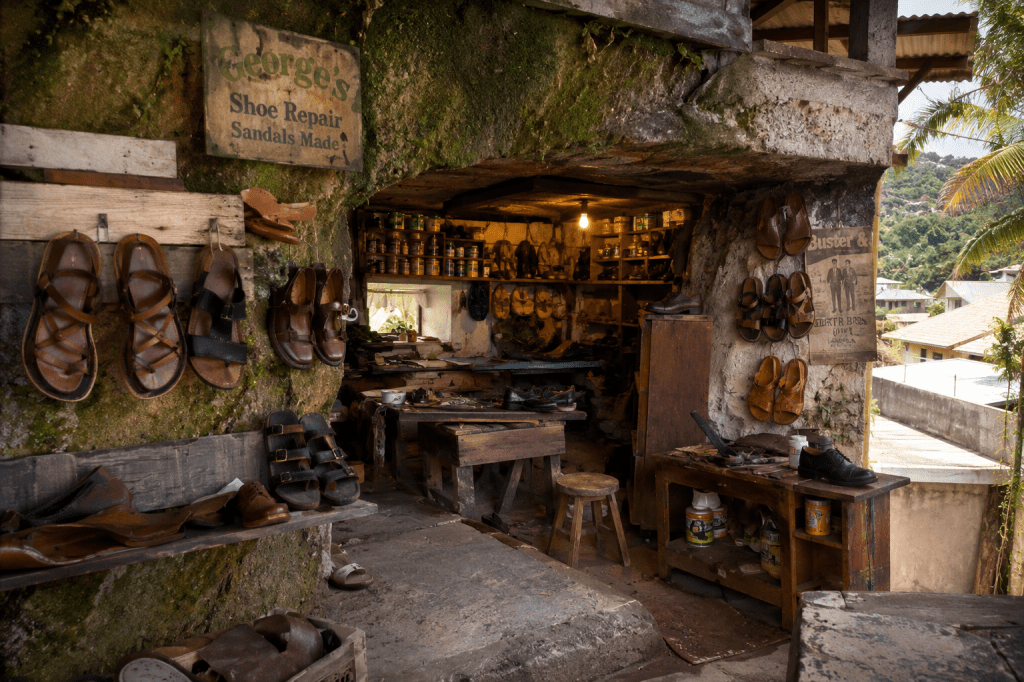
There was a shoemaker down the road from my grandmother’s house in Tucker District, Montego Bay that everyone called Shoey.
That probably sounds ridiculous outside of Jamaica, but in Jamaica, nicknames become identities. If you repaired shoes for thirty years, congratulations, your government name no longer mattered.
Shoey lived and worked under a house bottom, in a little concrete space built beneath someone else’s home. As a child, I thought it looked like a cave. The walls were rough stone with patches of moss growing between them from years of damp mountain air. Leather scraps hung from nails. Old sandals lined shelves beside jars of glue and tiny coffee tins filled with nails.
And despite how bare it was, Shoey kept it clean.
I remember a mattress stuffed with hay sitting against the wall where he slept. Not a proper modern mattress. The kind that looked handmade and old even back then. There was very little in that room besides his tools, some shoes in various states of repair, and whatever groceries or odds and ends he’d picked up from the nearby shop.
But Shoey himself always looked tidy.
He was older than my cousin by a good margin and had maybe five teeth left, four of them in rough condition. I say this not to mock him, but because it became part of the family joke later. Everyone knew Shoey was deeply smitten with my cousin, who had come to live with my grandmother for a while.
My cousin was beautiful in the way people in Jamaica openly comment on. Light skin. Long hair. Fine features. The kind of beauty that people believed could change your circumstances if leveraged correctly. But her family was poor. She wore her hair mostly in plaits because chemical relaxers and salon upkeep cost money.
Shoey adored her anyway.
Every time we passed his shop, he’d offer her something.
Leather sandals he made himself. Crackers. Cheese. Little treats from the shop nearby. Sometimes money toward something she wanted. He watched her the way lonely men watch beautiful women they’ve already built dreams around in their heads.
But everybody knew my cousin wasn’t interested.
What Shoey did not know was that she already had a boyfriend she’d been secretly seeing for months.
My grandmother eventually got irritated by the entire arrangement and bluntly told Shoey the truth.
“Stop wasting your money. She already has a man.”
Just like that.
No softening. No diplomacy. Straight to the point the way older Jamaican women often are.
Shoey was crushed.
And strangely enough, the bigger scandal afterward wasn’t even my cousin hiding the boyfriend. It was her mother being upset that my grandmother had interrupted the gifts and potential financial help.
I still remember her mother saying she would have dated Shoey herself if it meant stability or support, though whether she fully meant it or was speaking out of frustration, I’ll never know.
But Shoey wasn’t interested in her mother.
He wanted the daughter.
Looking back now as an adult, I understand the situation differently than I did as a child. Back then it was funny village drama to me. Now I see poverty sitting quietly underneath all of it. Attraction. Survival. Beauty functioning like currency. Adults calculating opportunities in real time.
But there’s something else I need to say about Shoey, because details matter and honesty matters.
Shoey never once disrespected me.
I know that sounds like bare minimum praise, but girls who grow up in unstable environments notice these things very clearly.
He never touched me inappropriately. Never made comments toward me. Never tried to blur boundaries. He treated me like what I actually was: a child.
And oddly enough, that left an impression on me.
Because when you grow up around enough chaos, basic decency becomes memorable.






Leave a Reply