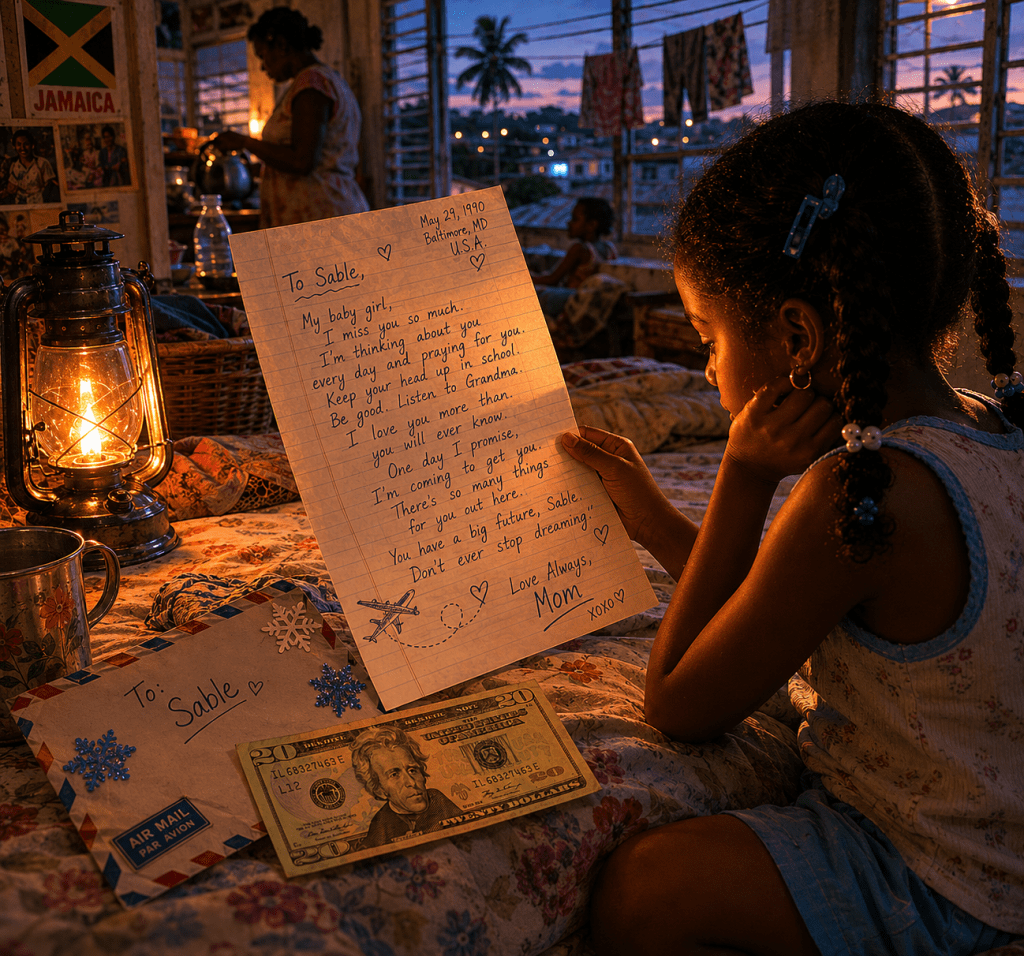
When I was living in Waterhouse with my father’s family, the letters from my mother became one of the few things I looked forward to consistently.
By then, my parents were separating, and my mother had already gone to America.
So there I was in Kingston 11, living with my father’s people alongside my little brother and my half-brother, trying to adjust to a life that never truly felt stable or welcoming.
My grandmother was there. My grandfather too. My aunts. My uncle had already left for America the year before.
And even as a child, I understood something important:
we were there because we had nowhere else to go.
The letters came about once a month.
My mother usually tucked Jamaican money inside for me. Not huge amounts. Just little pocket money because she knew I was a child and could not exactly go exchange foreign currency on my own.
Still, it meant something.
The envelopes carried hope.
Then Hurricane Gilbert hit Jamaica.
I still remember the aftermath in Waterhouse. No electricity for weeks. Hot, dark nights. The entire area felt exhausted afterward.
For a while, we barely had enough to drink.
A lot of people in the area did not even have running water, but luckily the outside pipe in our yard still worked. So the adults boiled water for drinking.
That boiled water tasted absolutely terrible.
And because there were so many people in the house, they never seemed to boil enough at one time for everybody to feel comfortable.
I remember being thirsty often.
Hungry too.
Eventually my father brought home a block of ice, maybe on the second day after the storm, and that helped tremendously. Before that, everything felt hot, sticky, and miserable.
My cousin Nicolette lived there too. Her mother was also in America, but unlike my situation, her mother regularly sent money home to my grandmother for her care.
Even as children, we noticed differences like that.
One day I wrote my mother explaining how difficult things were after the hurricane. I told her how thirsty I had been.
When her response finally arrived, she told me she felt bad for me and suggested that I bury a bottle of boiled water underground to help keep it cool naturally.
I never actually tried it.
By the time the letter reached Jamaica, the water situation had already improved.
That is another thing people forget about letters from that era. Communication moved slowly. By the time comfort arrived, the suffering it responded to had often already passed.
Still, I waited for those letters constantly.
Because the letters were not just letters.
They were emotional escape routes.
Inside them existed:
America.
Snow.
Airplanes.
A new life.
A future.
My mother wrote about bringing us there to live. She told me about her new boyfriend too, the American man who eventually became my stepfather.
At the end of one of the letters, he added a small note in his own handwriting.
I remember immediately noticing that the writing looked completely different from my mother’s.
Even that felt exciting to me.
An American man with an accent sounded exotic and hopeful in my child imagination. At that point in my life, I believed American men were probably kinder, calmer, and safer than the Jamaican men I had known growing up.
So while I was living in a crowded house in Waterhouse after Hurricane Gilbert, drinking terrible boiled water and waiting for electricity to return, I was also building an entire fantasy life in my head from envelopes arriving through the mail.
The letters gave me something I desperately needed at that age.
Hope.


Leave a Reply