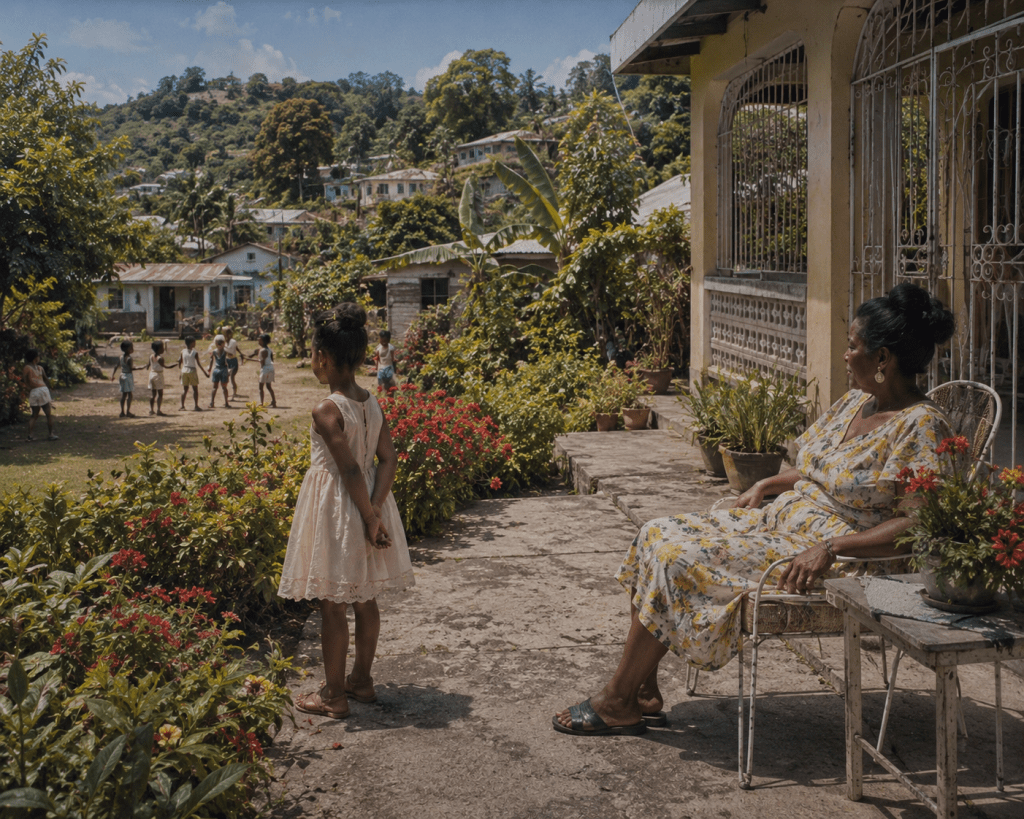
Growing up in Tucker Bottom, Montego Bay, I wasn’t allowed to play with most of the children in my neighborhood.
That sounds dramatic, but it wasn’t because the neighborhood was dangerous. It wasn’t because the children were mean. It wasn’t because my grandmother worried about bad influences.
It was because she had rules.
Some children were off limits because they weren’t related to us. Others were off limits because of disagreements between adults. The result was the same either way.
There were children everywhere.
I just wasn’t allowed to play with many of them.
One of those families belonged to a woman I’ll call Inez.
To understand why, you first have to understand my grandmother.
According to Grandma, when she and my grandfather first moved to Tucker Bottom, they lived well. My grandfather worked at one of the tourist hotels, and somehow our household always seemed to have good food. Eggs. Meat. Things that were not always guaranteed luxuries in the neighborhood.
Grandma used to say that whatever the Prime Minister ate, we ate.
Whether that was literally true or not didn’t matter. The point was that she was proud. In her mind, her family lacked for nothing.
She was also generous.
One of the people she helped was Inez.
From what I was told, Grandma regularly shared food with her family. Then one day she discovered that Inez had fed some of the eggs she had been given to her dog.
That was it.
Diplomatic relations collapsed.
To this day, I don’t know whether the dog received one egg, two eggs, or an entire breakfast buffet. What I do know is that the incident became part of family history.
Grandma viewed it as disrespect.
She had given food to help a family, and in her mind that food had been wasted.
Inez may have had her own version of events. I never heard it.
What I heard was Grandma’s version.
And in our house, Grandma’s version was the official version.
The interesting thing about childhood is that you inherit conflicts before you inherit context.
I didn’t know Inez.
I didn’t witness the egg incident.
I wasn’t alive when the argument happened.
But I inherited the consequences anyway.
Her children lived nearby.
I wasn’t allowed to play with them.
The logic seemed perfectly normal to the adults.
Grandma didn’t like Inez.
Therefore, we didn’t like Inez.
Therefore, we didn’t associate with Inez’s children.
Case closed.
Children rarely get a vote in these matters.
Looking back, I find it funny how often adults expect children to carry emotional luggage they never packed.
I wasn’t allowed to build my own opinion of Inez.
I wasn’t allowed to decide whether her children were nice.
I inherited a feud the way some people inherit furniture.
It was simply handed down.
As a child, I accepted it because children accept all sorts of strange rules.
As an adult, I laugh at the absurdity of it.
Imagine being banned from an entire family because of an egg-related disagreement that occurred years before your birth.
Yet at the time, it was completely normal.
That was how loyalty worked.
That was how family worked.
That was how neighborhoods worked.
When Grandma didn’t like someone, neither did the rest of us.
The funny part is that I barely remember Inez.
What I remember is standing on the outside looking in.
I remember seeing children my age and understanding that some invisible adult decision had already been made.
They were close enough to see.
Close enough to hear.
Close enough to become friends.
But not close enough to cross the border drawn by a disagreement that wasn’t mine.
The Inez family wasn’t the only family on that list.
There were others.
By the time all the rules, grudges, and restrictions were added together, my world became surprisingly small.
People often assume loneliness means being physically alone.
I wasn’t physically alone.
I lived in a neighborhood full of people.
I went to school with children my age.
I had cousins.
What I lacked was freedom.
Freedom to walk across the yard.
Freedom to knock on a door.
Freedom to decide for myself who my friends would be.
All these years later, I still think about how strange that is.
The eggs are funny.
The feud is funny.
But the loneliness wasn’t.
Whatever the Prime Minister Ate, We Ate
Growing up in Tucker Bottom, Montego Bay, I wasn’t allowed to play with most of the children in my neighborhood. Some were off limits because they weren’t family. Others were off limits because of adult feuds that began long before I was born. One such feud started over a few eggs, a dog, and a…
3–5 minutes
Caribbean childhood, Childhood Loneliness, childhood memories, family dynamics, Family Feuds, grandmother stories, growing up in Jamaica, Jamaica, Jamaican childhood, Jamaican culture, Jamaican Family, Jamaican Storytelling, Life in Jamaica, memoir, memoir blog, Montego Bay, Neighborhood Life, personal essay, Sable Monroe, Tucker Bottom
One response to “Whatever the Prime Minister Ate, We Ate”
-
[…] Whatever the Prime Minister Ate, We Ate—> […]
LikeLike






Leave a Reply