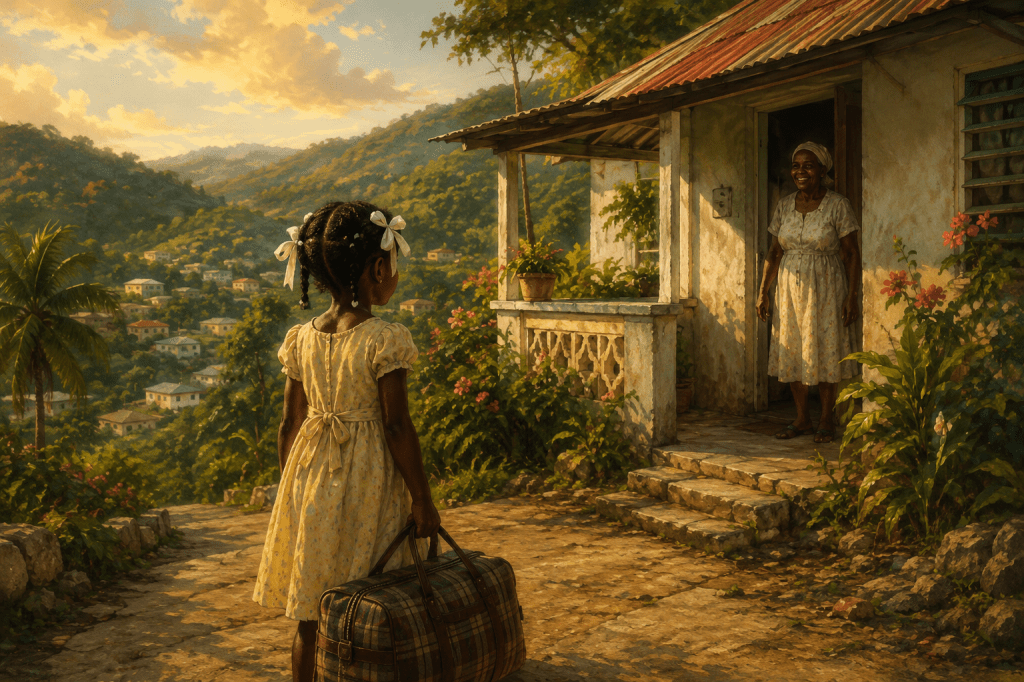
Whenever things exploded between my parents, I already knew what came next.
My mother would start packing my clothes.
Not carefully. Not sentimentally. Just fast, irritated movements while tension still hung in the air from whatever fight had happened. Sometimes there had been yelling. Sometimes violence. Sometimes one of those long cold silences that somehow felt even worse.
Then she’d say it.
“You’re going to your grandmother’s.”
Or, in Jamaican language:
“You a go country.”
Country meant Montego Bay.
Back then, the drive from Kingston to Montego Bay felt endless. We’d leave in the morning and not arrive until afternoon. The roads twisted through the hills, and almost every time, I got carsick. I don’t know if I simply had a sensitive stomach as a child or if my body already associated movement with stress, but I remember vomiting more than once during those trips.
Still, none of it mattered once we got there.
The second I saw my grandmother, I felt my body relax.
That feeling is difficult to explain because children are supposed to feel safest with their parents. But when my mother dropped me off in Montego Bay and eventually returned to Kingston without me, I felt relief.
Real relief.
The kind where your nervous system unclenches before your brain even catches up.
I never arrived with much. Usually just clothes and schoolbooks. Sometimes not even my doll. My life would abruptly shrink down into whatever fit inside a small bag.
And then I would settle into my grandmother’s world.
Compared to Kingston, Montego Bay felt slow and quiet. Peaceful, but also boring in the way childhood often becomes when adults are surviving instead of entertaining children.
My grandmother believed strongly in reading.
“Take up your book,” she’d always tell me.
So I read. A lot.
But eventually, even books run out for a child.
The television in the house was black and white and only worked sometimes. Back then in Jamaica, television wasn’t twenty-four hours a day. The station would sign on in the morning and eventually sign off around midnight. We mostly watched JBC, the only channel available at the time.
Right above the house sat a church, and on Sundays you could hear the choir singing through the hills before you even saw anyone dressed for service.
Ironically, my grandmother herself rarely stepped foot inside the church.
She had ongoing issues with some of the church sisters and refused to deal with their politics directly. But she still sent me every Sunday like a tiny family representative.
And she made sure I looked good doing it.
She would take me to the dressmaker to have beautiful dresses sewn. Matching satin ribbons too, carefully chosen in Montego Bay before Sunday service. I’d arrive polished, carrying collection money from my grandmother, expected to represent the family properly whether I fully understood any of it or not.
That was very Caribbean.
Even now, I smile thinking about it.
But the house itself wasn’t entirely peaceful.
My grandmother didn’t live alone. My aunt, my mother’s older sister, lived there too. So did my uncle, my mother’s younger brother. And even as a child, I noticed something that disturbed me.
None of them respected her.
They snapped at her constantly. Called her foolish. In Jamaican terms, “fool fool.” They dismissed her opinions, spoke over her, and treated her with a level of irritation that confused me because, to me, my grandmother felt gentle and safe.
As a child, I couldn’t understand why they spoke to her that way.
Years later, as an adult, I asked one of my cousins about it. I remember saying something like:
“Why were they all so disrespectful to Grandma?”
And my cousin answered almost immediately.
Because that’s what they saw growing up.
Their father had disrespected their mother openly, and eventually the children learned to do it too.
The moment she said it, something clicked into place inside me.
Suddenly, it all made sense.
Children normalize what surrounds them. Even disrespect can become inheritance.
Looking back now, Montego Bay was complicated. It was the safest place in my childhood, but also one shaped by loneliness, silence, and generational wounds I was too young to fully understand.
Still, when the chaos in Kingston became too much, it was the place where my body finally learned what temporary peace felt like.
<—-Previous Post Grandma’s Love in Tucker District Montego Bay




Leave a Reply