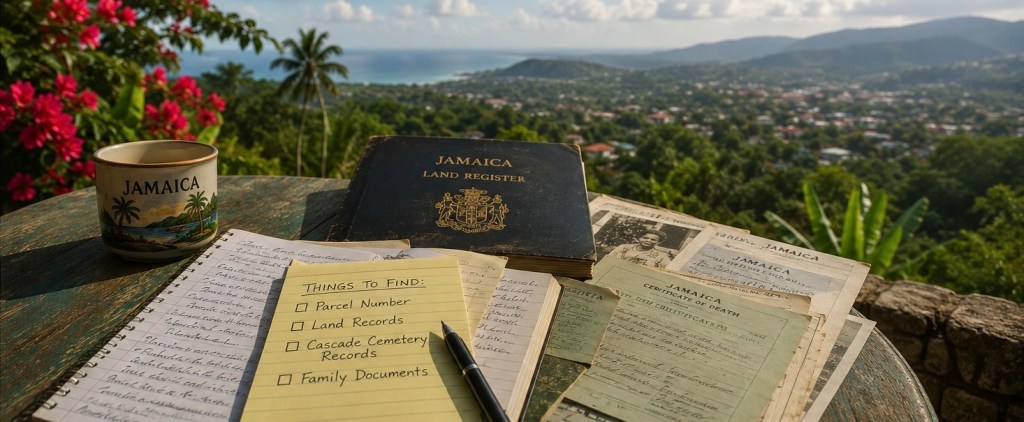
I thought once I got back to Jamaica, I’d just ask around and someone would point me to my grandmother’s grave.
That was incredibly naïve.
As it turns out, finding a burial site and tracing family land are two completely different challenges. Over the past few weeks, I’ve been learning that genealogy isn’t just about collecting old records. It’s about figuring out who knows what, who keeps the records, and who can actually help you make sense of them.
When I first started this journey, I assumed there would be one obvious person to call. Instead, I’ve found myself trying to figure out which type of professional is best suited to help.
My first stop was an attorney.
She quoted me approximately $1,100 for the work. I don’t mind paying professionals for their expertise. If someone has knowledge that I don’t, that’s valuable. My hesitation wasn’t really about the price. It was that I didn’t fully understand what the fee covered. Before I spend that kind of money, I want to know exactly what work is being done on my behalf.
So I kept looking.
The second attorney approached things differently.
He explained that locating the property would likely require the parcel number. That made perfect sense. Unfortunately, that’s one of the very things I’m trying to find. Once I have that information, I think he may be able to help me move the search forward. Until then, we’re both a little stuck.
That led me to a professional genealogist.
Her process made a lot of sense to me.
Instead of giving me one flat price, she explained that genealogical research is billed by research hours. She offers research in blocks of approximately eight to ten hours at a rate of $55 per hour. Depending on how complicated the search becomes, it may require one block or several.
What I appreciated most was that she didn’t immediately try to sell me anything.
Instead, she offered to review everything I’ve already gathered, including birth certificates, death certificates, family names, locations, and all the research I’ve been doing on my own. After reviewing my information, she’ll be able to estimate how many research hours I’ll actually need instead of having me pay for work that may not be necessary.
That felt like a very reasonable place to start.
One thing this experience has taught me is that genealogy isn’t a straight line.
Every document answers one question while creating three new ones.
One certificate points to another relative. One relative leads to another parish. One conversation sends you looking for another record that you didn’t even know existed.
It’s less like reading a history book and more like putting together a thousand-piece puzzle when you aren’t even sure all the pieces still exist.
The funny thing is, I started this journey thinking I was looking for one grave.
Somewhere along the way, it became something much bigger.
Now I’m trying to preserve the story of an entire family before more of it disappears.
The older I get, the more I realize that memories disappear faster than we think they will. The people who know the stories grow older. Records get misplaced. Land changes hands. Cemeteries become overgrown. Before long, entire branches of a family can slowly fade into history.
If one of my descendants decides to ask these same questions fifty years from now, I don’t want them to have to start where I did.
I’d like to leave them something better than questions.





Leave a Reply