The last time I saw my mother in Jamaica, my parents were fighting at my school.
Not arguing.
Fighting.
Their marriage had already fallen apart, though neither of them seemed entirely willing to admit it. They were separated, but not divorced. My father was living with his girlfriend. My mother was preparing to leave for America. Like many children, I understood far more than the adults around me realized.
A few hours later, my father put my younger brother and me into the car.
We drove to Waterhouse.
I didn’t know exactly where we were going, but I knew something had changed.
What I didn’t know was that my father was about to ask his mother for a favor.
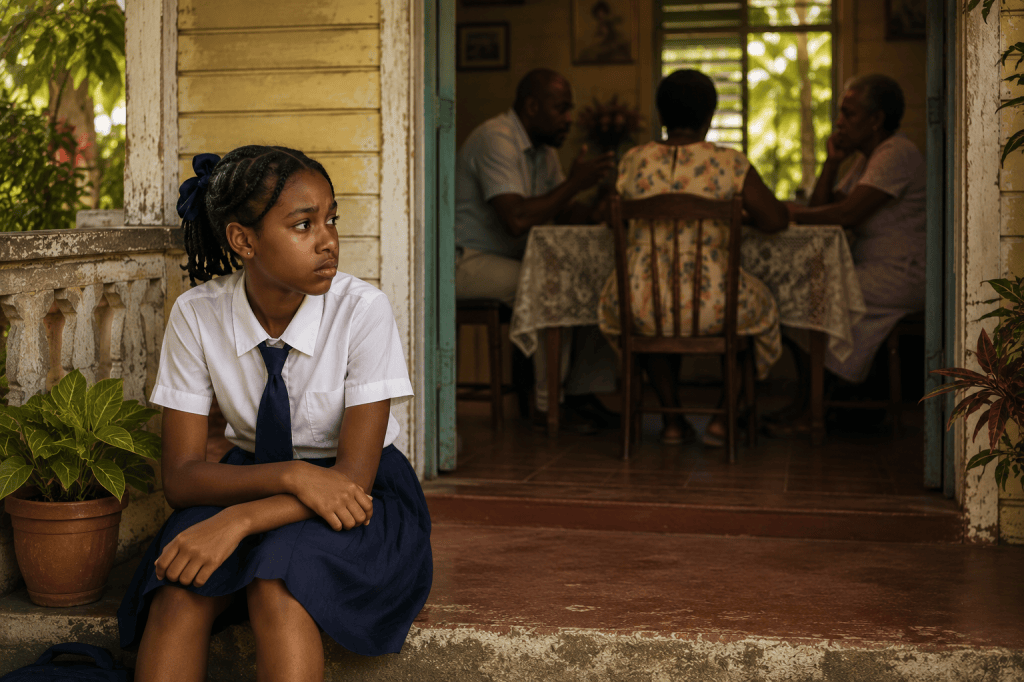
When we arrived, my brother and I sat on the veranda while the adults talked.
At first it was talking.
Then it became arguing.
I listened as my grandmother complained that the house was already full. There wasn’t enough room. There wasn’t enough money. She couldn’t afford two more mouths to feed.
I was eleven years old.
I understood every word.
Children hear more than adults think they do.
I knew they were talking about my brother and me.
I knew they were discussing whether we could stay.
I knew money was the problem.
And as I sat there in the Jamaican heat listening to adults debate our future, I started to cry.
Someone asked me what was wrong.
I remember answering through tears:
‘Because nobody wants us.’
The arguing stopped.
For a moment, everyone became quiet.
Looking back as an adult, I can appreciate that the situation was probably more complicated than I understood at the time. There were financial pressures. My grandmother had legitimate concerns. The adults were trying to solve problems I couldn’t fully see.
But eleven-year-old me didn’t see financial logistics.
I saw adults arguing over whether there was room for me.
And from where I sat on that veranda, those two things felt exactly the same.
That was the beginning of my time in Waterhouse.
The refrigerator would become off-limits.
The television would become a source of conflict.
I would learn to wash my own clothes and my younger brother’s clothes by hand.
I would discover what it felt like to live in a house where I was tolerated more than welcomed.
But all of those stories came later.
This was the first one.
The day I learned that children can hear every word adults say about them.
And the day I became convinced that nobody wanted us.
Nobody Wanted Us
Children hear more than adults think they do. At eleven years old, I listened as the adults around me quietly debated whether there was room for my brother and me. They were talking about money. I heard something else entirely: Nobody wants us. It was a misunderstanding born from a child’s perspective, but it shaped…






Leave a Reply