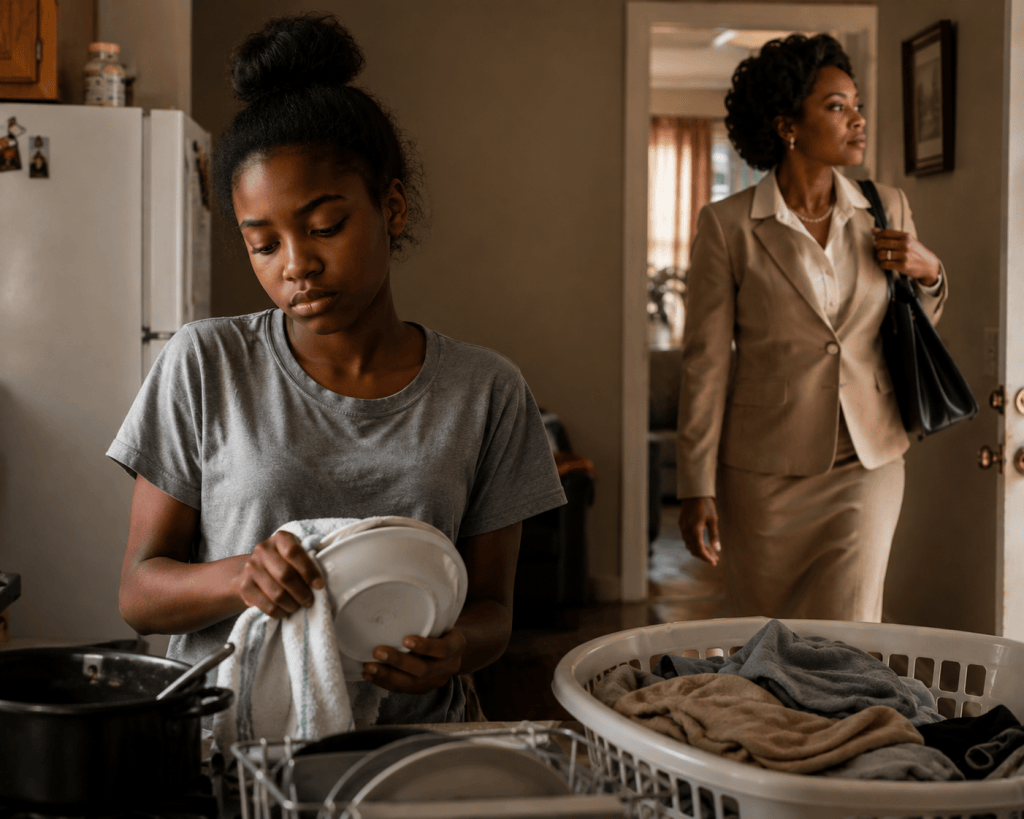
My mother loved being a professional woman.
I remember the stilettos. The pantyhose. The skirt suits and business-casual clothes. Her makeup done, her hair done, getting ready to go to a desk job. There was an identity attached to all of it that seemed important to her. Respectability. Achievement. Prestige.
She liked school, too. She liked studying. She wanted a career, and after immigrating to the United States, she was determined not to remain in domestic work any longer than necessary.
I understand that ambition much better as an adult than I did as a child.
What I understand differently now is who was expected to absorb the cost of it.
My mother had two children, a household, an unstable marriage, work, and school. Something had to give.
Increasingly, that something was me.
I became the junior mother.
While my mother studied and worked toward the life she wanted, I was expected to help cook, clean, look after my younger brother, and eventually take on responsibilities that belonged to adults.
The strange thing is that I had seen this arrangement before.
My grandmother had spent much of her life doing domestic labor for other people. She cooked. She cleaned. She cared for children. She made herself useful to everybody around her.
My mother did not seem to respect that life very much.
She wanted something different for herself.
But without ever saying it plainly, she seemed to expect me to become a younger version of the woman she was trying so hard not to be.
Someone had to pick up the domestic slack while she pursued her education and career.
Apparently, that someone was supposed to be her teenage daughter.
There was only one problem.
I wanted a life too.
I had school. I wanted friends. I wanted boyfriends. I wanted to go places and experience things. More than anything, I wanted periods of time when I didn’t have to be inside our chaotic home.
As I got older, I became increasingly unavailable for the role that had been assigned to me.
I wasn’t becoming selfish.
I was becoming a teenager.
And I think that was part of the conflict between my mother and me that I didn’t fully understand at the time. My independence wasn’t simply independence. Every hour I spent somewhere else was an hour of labor she could no longer count on.
She once told me when I was around sixteen that if she could do her life over again, she wouldn’t have children.
She would have her career.
Another time, she told me that if it weren’t for my brother and me, she wouldn’t even need her own place. She could have a boyfriend and stay at his house without having to pay all those bills.
Those statements stayed with me.
As an adult, I can understand that some people regret becoming parents. I can even understand a woman looking backward and imagining an entirely different life for herself.
What I cannot accept is making children pay for a decision they didn’t make.
I didn’t choose motherhood for my mother.
I didn’t choose her marriage.
I didn’t choose immigration.
I didn’t choose her career.
And I certainly didn’t agree to surrender my adolescence so the adults around me could pursue the lives they wanted.
When I finally left home at eighteen, my mother blamed me for many of the problems that followed.
For years, I understood that mostly as anger over losing control.
Now I think there was another loss buried underneath it.
She lost my labor.
The daughter who cooked, cleaned, helped with children, absorbed emotional chaos, and filled whatever gaps the adults left behind was no longer available.
I had resigned from a job I had never applied for.
Leaving home at eighteen made my life harder in some ways. I didn’t have much money. I didn’t have the security young people ideally should have when they begin adulthood. I was still figuring out how I was going to survive.
But I had something I hadn’t had before.
Ownership of my own time.
And looking back now, I don’t question the decision.
Leaving home at eighteen was one of the best things I ever did for myself.
My mother was entitled to want a career.
She was entitled to want education, success, beautiful clothes, a desk, financial security, and a life that felt bigger than domestic work.
She just wasn’t entitled to build that life out of mine.






Leave a Reply