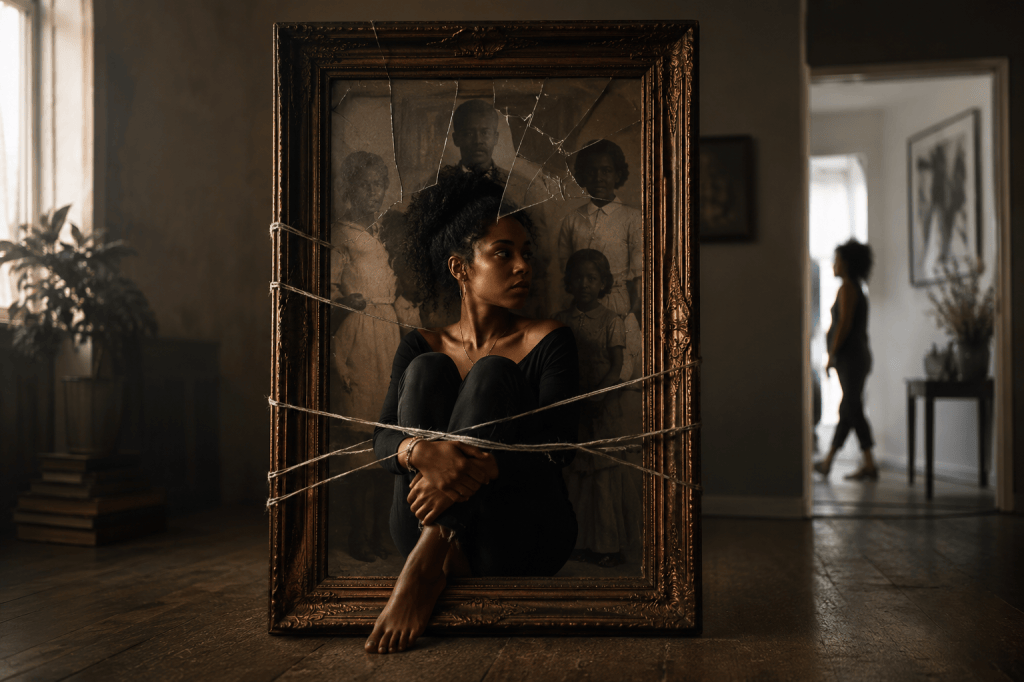
Families have a strange habit of deciding who you are before you’ve finished becoming anyone.
The good child.
The difficult child.
The smart one.
The irresponsible one.
The successful one.
The disappointment.
Once you’ve been assigned your part, you can spend the rest of your life presenting evidence that the casting was wrong.
Sometimes it doesn’t matter.
My mother put me in a category when I was young.
I never graduated from it.
I grew up.
I left home.
I became independent.
I got married.
I raised children.
I built a life.
None of those things automatically changed the position she believed she occupied in relation to me.
She was still Mother.
I was still Daughter.
And Mother, in her mind, apparently retained certain privileges.
The privilege of judgment.
The privilege of advice.
The privilege of interference.
The privilege of assuming that because she had an opinion about my life, I should value it.
I didn’t.
That became one of the most insulting things I could do to her.
I didn’t need to curse her out.
I didn’t have to call her a dumb bitch to her face.
I could simply communicate:
I don’t value your opinion.
That’s colder.
When I was newly married and she tried giving me relationship advice, I told her that if she had a relationship I wanted to emulate, I would listen.
She told me I hurt her feelings.
I wasn’t sorry.
I thought:
Good. It landed.
Because I wanted the message to land.
All the credentials in the world couldn’t make me respect judgment I had already decided was poor.
Age couldn’t do it.
Education couldn’t do it.
Motherhood certainly couldn’t do it.
She had placed me into a category I could never graduate from.
What I didn’t realize until much later was that I had done something remarkably similar to her.
I put her in a category too.
And she couldn’t graduate from mine either.
In my mind, she became a dumb bitch.
Not temporarily.
Not because I was having a teenage tantrum.
It became part of the psychological architecture through which I understood her.
When I was young and still living with her, that architecture protected me.
I couldn’t physically escape yet, so I stripped her of psychological authority.
I examined her choices.
Her contradictions.
Her relationships.
Her failures.
Her treatment of me.
And I reached a conclusion:
This is not someone whose judgment I should use to measure myself.
That conclusion helped me survive.
But survival strategies have an interesting habit.
Sometimes the emergency ends and the software stays installed.
Nearly twenty years have passed since I last spoke to my mother.
Recently, I Googled her.
I didn’t click on her Facebook profile. I had no interest in potentially announcing myself through some algorithmic suggestion.
But I saw what appeared to be a recent photograph.
I recognized her immediately.
She looked older.
Visibly older.
And my mind updated exactly one piece of information.
Old bitch.
That’s it.
There was no swelling orchestral score.
No sudden realization that time is precious.
No desire to reconnect with my aging mother.
No moment where I gazed upon her older face and discovered that decades of distance had transformed contempt into tenderness.
She was simply older.
The software still worked.
That realization made me notice something uncomfortable.
My mother and I had done something similar to each other.
She created a version of me and apparently expected that version to remain available indefinitely.
I created a version of her too.
Neither of us offered the other automatic promotion.
There is an important difference, at least from where I stand.
I experienced my judgment of her as a response to what she actually did to me and what I repeatedly observed.
I wasn’t required to esteem someone simply because she gave birth to me.
Respect is not hereditary.
But recognizing why I formed my judgment doesn’t erase the symmetry.
She put me in a category I couldn’t outlive.
I put her in a category she couldn’t outlive.
And maybe that’s one of the darker things families pass down.
Not merely behaviors.
Categories.
I saw some version of it in the generation before us.
My mother did not respect her own mother.
Neither did my aunt or uncle, from what I observed.
My grandmother’s children had their judgments about who she was.
My mother had hers.
Then my mother became somebody’s mother.
And eventually her daughter had a verdict too.
Different relationships.
Different circumstances.
Different reasons.
But the structure rhymes.
I know what you are.
Once that sentence hardens inside a family, changing someone’s mind can become nearly impossible.
Perhaps that’s why family relationships can be uniquely maddening.
A stranger meets the person you are today.
Family often meets your archive.
They remember the child who lied.
The teenager who rebelled.
The sibling who failed.
The daughter who disappointed everyone.
The son everybody protected.
Twenty years can pass and someone still opens the same fucking file.
Sometimes the file isn’t even accurate anymore.
Sometimes it never was.
And sometimes?
The file is ours.
That’s the part I’m willing to admit.
I have a file on my mother.
It is not flattering.
I have added information over the years, but the fundamental classification hasn’t changed.
I don’t hold her in high esteem.
I don’t value her judgment.
I don’t look back and discover wisdom simply because she is old now.
Aging is not character development.
Gray hair does not retroactively make somebody wise.
Time passing doesn’t rewrite history.
And distance doesn’t automatically create affection.
Maybe some people experience that.
I didn’t.
What distance gave me was clarity about the permanence of my own judgment.
I can recognize the mechanism without pretending I’ve dismantled it.
I can understand that my mother froze me in a role while acknowledging that I froze her in one too.
And I can understand that without arriving at the fashionable conclusion that therefore we were equally wrong.
Understanding a pattern does not require flattening every distinction inside it.
Sometimes two people do something structurally similar for very different reasons.
Sometimes recognizing your own participation in a pattern doesn’t make you want reconciliation.
Sometimes awareness is simply awareness.
There doesn’t have to be a redemption arc afterward.
My mother may have spent decades carrying around an outdated version of me.
Perhaps somewhere in her mind I am still whatever daughter she decided I was.
I wouldn’t know.
I haven’t spoken to her in nearly twenty years.
Meanwhile, somewhere inside my own head, she remains filed under a category I created a long time ago.
The photograph changed.
The woman got older.
The file remained where I left it.
She couldn’t update me.
I never updated her.
Maybe that’s another family inheritance.
Not forgiveness.
Not reconciliation.
Just two people living long enough to become strangers while carrying obsolete versions of each other in their heads.
And sometimes the strangest part isn’t realizing someone else never allowed you to change.
It’s realizing you never allowed them to change either.
Then looking at that realization and thinking:
Yeah. I know.
And leaving the file exactly where it is.



 Sable Monroe
Leave a comment