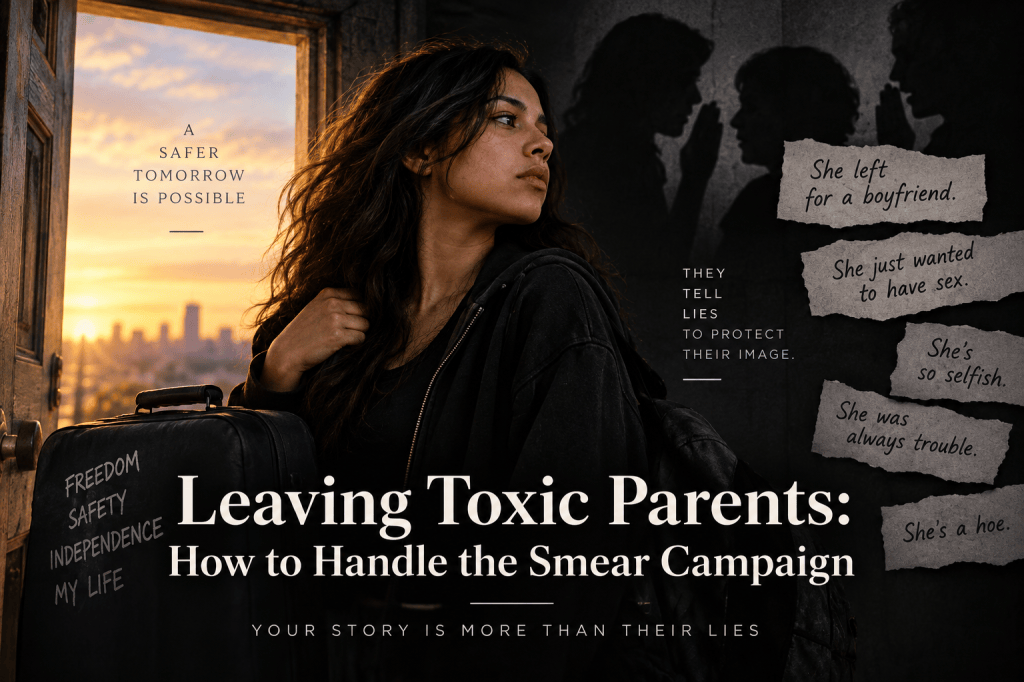
Before You Leave Toxic Parents, Be Prepared for the Smear Campaign
When I left home at eighteen, my mother told people I left because I wanted to have sex.
Apparently, I had a boyfriend and wanted to run around with him.
That was the story.
Not the instability in the house. Not the abuse. Not the chaos. Not everything that had accumulated over the years until I finally decided I would rather take my chances in the world than continue living there.
No.
I wanted dick.
Now, I’m not saying eighteen-year-old me didn’t want dick. Let’s not rewrite history unnecessarily.
I had a boyfriend. I loved him. I wanted to be with him. I was eighteen years old.
But wanting a boyfriend was not why I left home.
I left because I couldn’t see my situation improving if I stayed.
And if you’re preparing to leave a dysfunctional family while you’re still young, there’s something you should understand before you walk out that door:
You may not be the only person telling the story of why you left.
Your parents will probably be asked too.
And you may not like their version.
Somebody Is Going to Ask Why You Left
When a young person leaves a seemingly intact family home unusually early, people notice.
Relatives ask questions.
Family friends ask questions.
Neighbors ask questions.
People want to know why an eighteen-year-old isn’t living with her mother anymore.
And that creates a problem for a parent who doesn’t want anyone examining what was happening inside the house.
Because imagine my mother telling the truth.
Imagine her saying:
My daughter was living in an unstable environment. Things had become so bad between us that she decided being undocumented, broke and eighteen years old in the world was preferable to continuing to live with me.
That’s an uncomfortable story.
People might start asking follow-up questions.
So there was a much easier explanation:
She wanted to have sex with her boyfriend.
Problem solved.
Now nobody has to examine the mother.
Everybody can examine the daughter.
A couple of years after I left, when I was trying to have a relationship with my mother again, I finally asked her something that had been bothering me.
“Why were you so mad that I moved out at eighteen? I had been telling you since I was twelve that I was going to leave.”
She said, “I know.”
That was it.
She didn’t tell me she had forgotten. She didn’t say my leaving had blindsided her. She acknowledged that she knew I had been planning to leave for years.
And that made the story she told other people even harder for me to understand. If she knew I had wanted out since I was twelve, why tell people that I left because of a boyfriend or because I wanted to run around having sex?
I can’t tell you exactly what she was thinking. She never explained it. But I know what the story accomplished: it gave people a reason to scrutinize my character instead of asking why a twelve-year-old girl had already decided that adulthood would be her escape.
She Saved Her Image by Tarnishing Mine
I understand the strategy much better now than I did at eighteen.
If my mother could make my departure about my sexuality, then she didn’t have to make it about her parenting.
I wasn’t escaping.
I was rebellious.
I wasn’t trying to build a life.
I was running behind a man.
I wasn’t responding to instability.
I was an ungrateful teenage girl who wanted freedom so I could do whatever I wanted.
And once you establish that story, everything else becomes easier to dismiss.
Of course she left. She was boy-crazy.
Of course she’s complaining about her mother. She’s rebellious.
Of course she says the house was dysfunctional. She’s trying to justify what she did.
It’s a remarkably efficient little story.
She saved her image by tarnishing mine.
And at eighteen, that hurt.
The Truth Was Much Less Convenient
I didn’t leave home from a position of strength.
I was undocumented.
I had no credit.
I didn’t have much money.
At one point, I was making about $120 a week.
I couldn’t simply approach adulthood the way another eighteen-year-old might.
I couldn’t look at college and say, Fine, I’ll live in the dorms.
I couldn’t assume that public assistance would provide a temporary bridge while I got on my feet.
Even getting ordinary employment wasn’t as simple for me as filling out an application and showing the documents everybody expected me to have.
I left home at a disadvantage.
I knew that.
And I left anyway.
My boyfriend at the time had seen enough of what was happening in my house to be appalled by it. He wasn’t wealthy. He was young too, making maybe $300 or $400 a week.
But he loved me.
For about a month, he gave me his paychecks and lived off his tips so I could get established.
Eventually, I became a server myself and started making roughly $300 to $400 a week.
That changed everything.
I could afford my life.
With him or without him.
The young man who helped me get out eventually became the father of my children.
So no, I didn’t attach myself to some random man because I wanted somebody to finance my escape.
We were two young people in love, working with imperfect tools.
He happened to be one of mine.
Sometimes You Use the Bridge That’s Available
People love giving ideal advice from safe places.
Don’t depend on a boyfriend.
Have money saved before you leave.
Get your own apartment.
Go to college.
Apply for assistance.
Get a better job.
Okay.
What happens when some of those doors aren’t available to you?
You use the tools you actually have.
That doesn’t mean every tool is safe.
A vulnerable young woman trying desperately to escape one bad household can very easily walk straight into another one.
Some people can smell vulnerability.
A man offering you somewhere to live may genuinely love you and want to help.
Another man may recognize that if you have nowhere else to go, he can control you.
Those situations can look remarkably similar at the beginning.
So be careful.
But don’t let somebody sitting comfortably on the internet convince you that an imperfect bridge is automatically a bad bridge.
Sometimes you don’t have Plan A.
Or B.
Or C.
Sometimes you’re on Plan fucking J.
You still have to get across.
Leaving May Hurt People You Love
There’s another part of leaving that people don’t talk about enough.
Sometimes the hardest people to leave aren’t the people hurting you.
They’re the people you love.
When I left home, my younger brother was still there.
I had helped raise him. In my mind, I was almost a junior mother to him.
When we were children, we used to fantasize about escaping together.
We were going to open a supermarket so we’d never have to worry about food.
We were going to open a laundromat.
We were going to build some little imaginary life where we didn’t have to deal with the adults and chaos around us anymore.
Then I got older.
I started dating.
I started developing a life outside the family.
And he felt me pulling away.
Years later, he told me how difficult my leaving had been for him.
I understand why.
When I walked out of that house, part of me felt like I was leaving my child behind.
My grandmother was there too.
She was my emotional mother.
I left her behind.
That hurt too.
But I was eighteen years old, undocumented, broke and trying to climb out myself.
I couldn’t carry everybody.
That’s one of the ugliest truths about survival.
Sometimes you have to put the oxygen mask on yourself first.
Not because everybody else stopped mattering.
Because if you don’t save yourself, you may not be able to save anybody.
Your Family May Punish You for Surviving
Leaving doesn’t necessarily end the family dynamic.
Sometimes it just changes its form.
They can’t control where you sleep anymore.
They can’t dictate when you come home.
They can’t use the same rules against you.
But they can still control the story they tell about you.
And if your departure embarrasses them, they may need a version of events in which they remain the reasonable parent and you become the unreasonable child.
Maybe they’ll say you’re selfish.
Maybe they’ll say you’re ungrateful.
Maybe they’ll say a boyfriend or girlfriend corrupted you.
Maybe they’ll say you’re mentally unstable.
Maybe they’ll say you were impossible to control.
Maybe they’ll tell people they did everything for you and still don’t understand why you left.
Maybe they’ll reduce you to a hoe.
Ask me how I know.
You Don’t Have to Win the Public Trial
This is the part I wish somebody had explained to me when I was young.
You may never convince everybody.
Some relatives will believe your parent.
Some people will decide that no matter what happened, you should have stayed because that’s your mother or that’s your father.
Some people will hear both versions and choose whichever one makes them most comfortable.
You can spend years presenting evidence for your own life.
Or you can live it.
That doesn’t mean you can never correct a lie.
It doesn’t mean you have to sit quietly while somebody destroys your reputation.
It means you should be careful about making being believed by everybody another condition of your freedom.
You already left the house.
Don’t spend the next ten years standing emotionally in its driveway arguing about why.
I Know Why I Left
My mother had her version.
I have mine.
And mine has the inconvenient advantage of being the life I actually lived.
Yes, I had a boyfriend.
Yes, I loved him.
Yes, I wanted freedom.
Yes, I wanted to have sex.
Again, I was eighteen. Let’s not be ridiculous.
But none of those things explain why I was willing to step into adulthood undocumented, broke, without credit, without a conventional safety net, and with almost nothing underneath me.
I left because staying looked worse.
And if you’re young and preparing to leave a dysfunctional home, I want you to understand something:
The people you leave behind may rewrite your reasons for leaving.
They may need you to be selfish so they don’t have to consider whether they were cruel.
They may need you to be rebellious so they don’t have to consider whether their rules were unreasonable.
They may need you to be promiscuous so nobody asks what was happening inside their house.
Let them have whatever story they need to sleep at night.
You have something more important to build.
A life that no longer requires their permission.



 Sable Monroe
Leave a comment