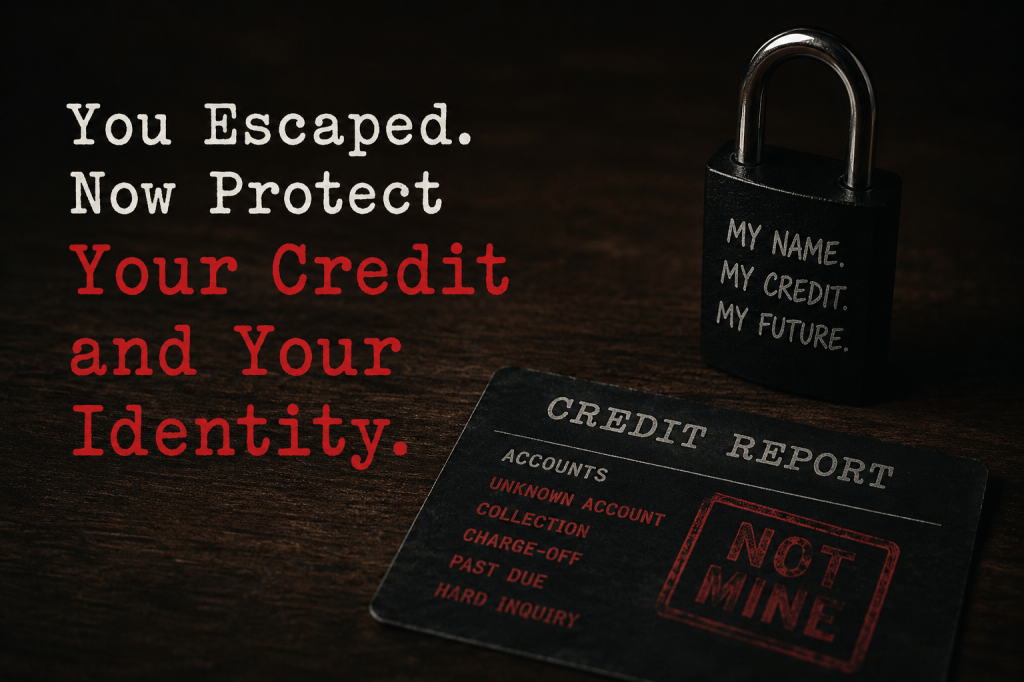
Getting out of the house is not necessarily the end.
Sometimes you get out and discover your parents already followed you.
Not physically.
Financially.
You apply for your first apartment and find a collection you don’t recognize.
You try to turn on electricity and discover you supposedly owe a utility company money from an address where you lived when you were fourteen.
You apply for a credit card and find out somebody already beat you to it.
Apparently, twelve-year-old you was very financially active.
Welcome to another fucked-up thing some parents do to their children.
Once You’re Out, Run Your Credit
This should be one of the first pieces of financial housekeeping you do once you are safely independent.
Pull your actual credit reports.
Not just your credit score.
Look at the accounts.
Look at the addresses.
Look at the collections.
Look at everything carrying your name.
You are trying to answer one basic question:
Has anybody been financially pretending to be me?
I was lucky.
Being undocumented created plenty of problems in my youth, but ironically, it may have protected me from this particular problem. I did not have the same financial footprint available for somebody to casually start opening American credit accounts in my name.
Other young people are not so lucky.
I have heard stories for years about parents putting utilities in their children’s names, opening accounts using their Social Security numbers, destroying the child’s credit and then sending that child into adulthood carrying bills they never created.
I remember being eighteen and renting a room after I left home.
Another young woman lived there with her little boy.
At some point, I noticed that the telephone service seemed to be in the baby’s name.
I was confused.
Why the hell does a baby have a telephone account?
Another roommate basically explained it to me:
The mother had fucked up her own credit, so apparently the baby got the phone.
I remember thinking:
Oh shit. People can do that?
That was my introduction to the concept.
Apparently, yes.
People really will fuck up their own financial identity and then start borrowing their children’s.
Your Parent Is Not Allowed to Borrow Your Identity
There is a difference between a parent helping a child establish legitimate credit and a parent secretly using a child’s identity to solve their own financial problems.
If somebody used your identity to open an account you did not authorize, that is not a family favor.
That is not:
“We were struggling.”
That is not:
“You benefited from the electricity too.”
That is not:
“I’m your mother.”
Your name was used to create a financial obligation without your permission.
Call the behavior what it is.
And once you are out, do not let family guilt convince you that you have to carry it.
This Is Where Empathy Can Fuck You
This is one of those places where my advice is probably going to upset somebody.
Good.
Imagine being nineteen or twenty years old.
You are making beginner money.
You are trying to get your first decent apartment.
You need transportation.
You might want a credit card.
Eventually you might want a car loan or a mortgage.
And before you have even had an opportunity to fuck up your own credit, somebody else has already fucked it up for you.
Then you find out it was your parent.
Now comes the guilt.
I don’t want Mom to get in trouble.
Dad was struggling.
She was doing what she had to do.
I don’t want to involve the authorities.
Okay.
But who is protecting you?
This is exactly what I mean when I say empathy can become dangerous when it is pointed in only one direction.
Everybody wants you to think about what might happen to the parent if the fraud gets reported.
Who is thinking about what happens to the twenty-year-old who starts adulthood with collections, fraudulent accounts, a fucked-up credit history and no money?
I know what I would do.
I would report it.
You may make a different decision.
But I would not destroy the beginning of my financial life in order to shield somebody who was willing to use my identity in the first place.
That is not a sacrifice I would make.
Dispute What Isn’t Yours
And this is where I want to be very precise because I am not an attorney, and you should not be taking current fraud procedures from somebody’s thirty-year-old life experience.
There is an actual identity-theft process.
The Consumer Financial Protection Bureau currently directs identity-theft victims to report the theft through IdentityTheft.gov and obtain an Identity Theft Report. That report, proof of identity and a letter identifying fraudulent information can be sent to credit-reporting companies to request that identity-theft information be blocked. Under current federal requirements, qualifying fraudulent information generally must be blocked within four business days after the credit bureau receives the required materials.
Notice what I did not say:
I did not say you automatically have to get your mother arrested before anybody will correct your credit.
The process is more specific than that.
A police report may be appropriate depending on what happened and what you’re being asked to document, but don’t assume you have to choose between “let Mom get away with it” and “send Mom to prison tomorrow.”
Find out what your situation actually requires.
Then handle it.
But handle it.
Don’t leave somebody else’s fraud sitting on your record because confronting it makes you emotionally uncomfortable.
Freeze Your Credit Too
If you find fraud, or even if you are simply worried that somebody who knows your Social Security number may try using it later, learn about credit freezes.
A security freeze can make it harder for somebody to open new credit accounts in your name, and federal law gives consumers the right to place one for free. A freeze does not clean up fraud that already happened and does not stop every type of identity theft, but it can close one more door.
Remember what I keep saying in Before You Can Leave:
Close doors behind you.
You got out of the house.
Now start closing the financial doors too.
Check More Than the Big Three Credit Reports
Here’s something I didn’t even know when I was young.
Your regular credit reports are not the only consumer reports that can affect your financial life.
Banks and credit unions may use specialty checking-account reports when deciding whether to let you open an account. Companies including ChexSystems and Early Warning Services maintain this kind of information, and consumers can request reports and dispute inaccurate information. The CFPB currently says nationwide checking-account reporting companies must provide a free report once every twelve months upon request.
So if you get out and something weird happens when you try to open a bank account, don’t immediately assume:
I guess nobody will give me an account.
Find out why.
There may be information attached to your identity that you didn’t create.
You cannot correct something you don’t know exists.
Separate Your Digital Life Too
Your financial identity is not only your Social Security number.
Once you are safely out, look at who has access to your email, phone account, passwords, banking information and account-recovery methods.
Change passwords somebody else may know.
Change PINs.
Check recovery email addresses.
Check who can access your phone plan.
Turn on stronger authentication where available.
Make sure important financial correspondence is going somewhere you control.
If you grew up in a controlling household, you may have spent years with adults knowing every password because they demanded them.
Independence means learning that other adults do not automatically get administrative access to your life.
You Are Starting From Zero. Protect Zero.
Young adulthood is financially hard enough when everything goes right.
You are usually not earning much.
You probably don’t have much savings.
You haven’t had decades to build credit.
You don’t own much.
Your net worth might essentially be:
Hello. I possess a mattress, three towels and ambition.
😂
That’s okay.
Zero is a perfectly respectable place to begin.
What you do not need is somebody handing you negative ten thousand before you’ve even started.
That’s why I take this shit seriously.
A young person leaving an abusive or dysfunctional household may already be emotionally exhausted. They may be learning adulthood without much help. They may have education costs, low wages, unstable housing and very little margin for error.
They do not also need to carry financial crimes somebody committed using their identity.
Being Family Doesn’t Make Fraud Less Real
This is another place where people get trapped by titles.
But that’s my mother.
Yes.
And?
That’s my father.
Okay.
Did you authorize the account?
No?
Then the relationship title doesn’t change the transaction.
This is something I had to learn in other areas of my life too:
Strip away the title and look at the behavior.
If a stranger opened three credit cards using your Social Security number, you would understand immediately that something was wrong.
Putting “Mom” in front of the person’s name does not magically transform fraud into love.
Sometimes family systems survive by convincing you that behavior becomes morally different when relatives do it.
It doesn’t.
Freedom Has Administrative Work
I wish leaving a dysfunctional family worked like a movie.
You walk out.
Music plays.
Door closes.
Credits roll.
No.
You walk out and eventually somebody wants your birth certificate.
Somebody wants a deposit.
Somebody runs your credit.
Somebody asks for identification.
Somebody wants employment history.
The electric company wants money.
The landlord wants paperwork.
Adulthood is extremely committed to forms.
That is why Part One was about leaving with your identification and documents intact whenever safely possible.
This is Part Two:
Once you’re out, find out what has already been attached to your identity.
Run your credit.
Read the reports.
Question accounts you don’t recognize.
Check specialty banking reports if circumstances suggest a problem.
Freeze your credit if that makes sense for you.
Dispute fraudulent information.
Document everything.
Use the official processes available to you.
And if somebody committed fraud in your name, make your own decision about reporting it based on the facts, the law and what protecting your future requires.
Do not make that decision solely around protecting the feelings or consequences of the person who used you.
You Got Out. Now Become Administratively Free.
Getting your body out of the family system is one kind of freedom.
Getting their voices out of your head is another.
Getting their hands out of your finances is another.
You may have to work through all three.
Take your time.
Do the paperwork.
Ask questions.
Keep records.
Do not assume something is legitimate simply because it has your name on it.
And don’t be embarrassed if you discover a financial mess you didn’t create.
Clean up what you can.
Dispute what isn’t yours.
Secure what belongs to you.
Then start building.
Because your parents already had their opportunity to make financial decisions in their own names.
They don’t get to spend your adulthood too.



 Sable Monroe
Leave a comment