You Think You’re Teasing Your Kid. You’re Making Them Vulnerable.
Families are often a child’s first mirror.
Before the rest of the world gets a chance to tell you what it thinks of your face, your body, your skin, your hair, your family has usually gotten there first.
Sometimes they tell you that you’re beautiful.
Sometimes they teach you exactly which parts of yourself you’re supposed to hate.
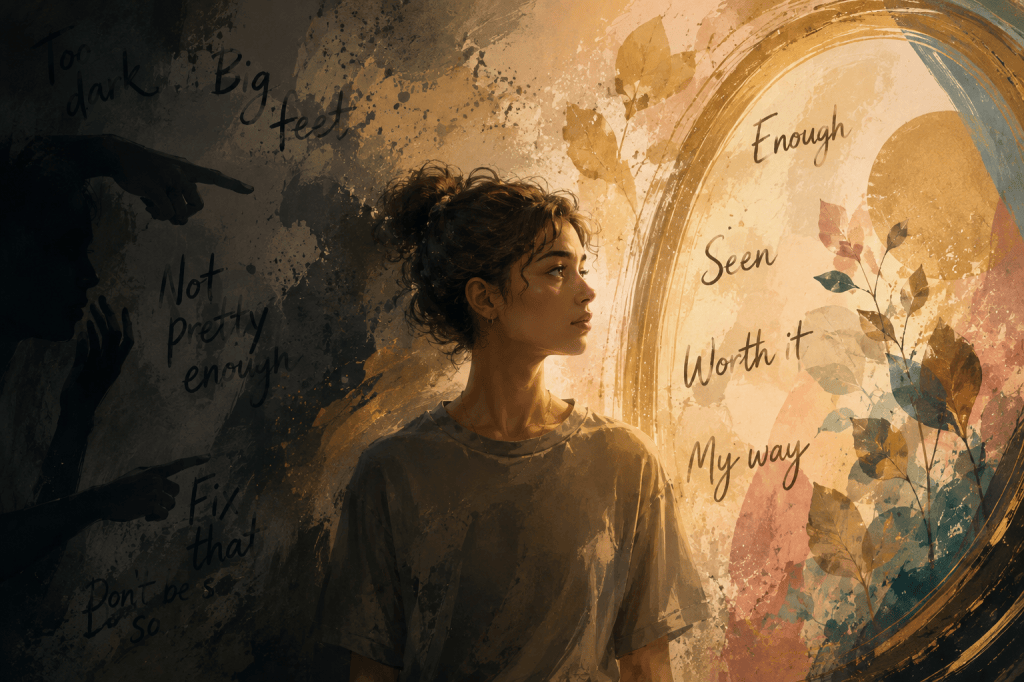
I learned early that my appearance was available for public discussion. My family could comment on it, joke about it, correct it, compare it and make it into entertainment. I was a child, so I didn’t have the language to call any of this colorism or body shaming or projection. I just learned the information they gave me.
This part of you is wrong.
That part of you is funny.
This feature makes you less attractive.
And when children hear something often enough from the people who are supposed to love them, they don’t necessarily think, These adults have unresolved issues and culturally distorted beauty standards.
They think, Okay. I guess that’s true.
My Body Was a Family Discussion
I grew up in Jamaica, where colorism was part of the environment around me. As a little girl, I played outside and got very dark in the sun. My dark-brown hair would lighten dramatically too, sometimes turning reddish.
I didn’t care.
I was a child. I wasn’t studying myself in the mirror trying to determine whether I met somebody’s beauty standard. As long as my face was clean and I didn’t have goo in my eyes, I had other shit to do.
But adults cared.
My mother would dye my sun-lightened hair black.
Looking back, that is crazy to me. The hair growing out of a little girl’s head had changed color from playing outside, and somehow it needed to be corrected.
My feet became another family project.
I had big feet. An uncle on my father’s side nicknamed me Sasquatch. My mother made comments about my feet too. Eventually I became so embarrassed by my shoe size that sometimes I would claim I wore half a size smaller.
Then my feet would hurt.
And somehow I could still get criticized for not choosing shoes that fit properly.
Nobody seemed interested in asking the obvious question:
Why is this child ashamed to say what size shoe she wears?
My feet weren’t the problem.
They needed shoes that fucking fit.
You Can Teach a Child an Insecurity
That’s the thing adults miss when they say they’re “just teasing.”
Children don’t arrive with a complete understanding of themselves.
Their families help build it.
If the people around you relentlessly point out your feet, your nose, your weight, your complexion, your hair texture, your stomach, or whatever feature has been selected for family entertainment, eventually you may start monitoring it yourself.
The joke moves into your head.
Then you leave the house.
That’s the part I think parents need to understand.
You don’t get to decide what happens to the insecurity after you create it.
A Crumb Can Feel Like a Feast
A child who has been taught that something about them is undesirable eventually meets people outside the family.
Some of those people will be kind.
Some will not.
And eventually, somebody may discover exactly what that child is starving for.
You told your daughter she was ugly.
Then somebody tells her she’s beautiful.
You told your son he was weak.
Then somebody makes him feel powerful.
You spent years laughing at a child’s body.
Then somebody comes along and tells that child their body is exactly what they want.
What do you think happens when someone has been starved of acceptance and somebody finally puts a crumb in front of them?
They may eat it fast.
When you haven’t been given enough love, you’ll lick it off a fucking knife.
That is what makes this more serious than hurt feelings.
You think you’re teasing your kid.
You may be lowering their price.
You may be teaching them that acceptance is rare enough that when somebody offers it, they should grab it before it disappears.
And the person offering it does not necessarily have good intentions.
I Didn’t Know I Was Pretty
For years, I thought I was somewhere between average and kind of ugly.
It didn’t consume me. I had a life to live. But it was part of what I believed about myself.
Then I turned sixteen.
That was also around the time my mother stopped buying my clothes. She told me that when she was sixteen, she bought her own clothes, so I would have to do the same.
Ironically, losing that support gave me something I hadn’t really had before.
Control.
I started buying clothes I actually wanted to wear. I got to decide how I presented myself instead of being dressed according to somebody else’s preferences.
And suddenly I started looking good.
Photographers began noticing me.
It wasn’t that I magically became a different human being on my sixteenth birthday. I finally had more control over the presentation of the person who had been there all along.
And I started getting information about myself from outside the family.
Apparently the verdict I had been given as a child wasn’t objective after all.
Then I Had a Daughter
Years later, when my daughter was born, my mother suddenly had an abundance of language about a little girl being beautiful.
She talked about how, when my daughter got older, she could be Miss Jamaica.
Interesting.
I don’t remember receiving that kind of celebration from her when I was the little girl.
Given the history between us, I experienced something else underneath those comments too. It felt as though my daughter’s beauty was being offered to me as a comparison, as if I were supposed to feel diminished by my own child.
I didn’t.
My daughter was beautiful.
That fact required absolutely nothing from me.
I didn’t need to be prettier than her. I didn’t need her to be prettier than me. I didn’t need to rank us at all.
I refused the competition.
The Inheritance I Wouldn’t Take
My mother has tried to leave me things before.
There was actual property. A house or property interest in Tucker. Land in Cascade.
I declined it because, to me, it wasn’t a clean gift. It came with strings and entanglements I did not want attached to my life.
Apparently there was another inheritance available too.
Her relationship with beauty.
Her competition between women.
Her colorism.
Her mother-daughter dysfunction.
Her need to turn one woman’s beauty into evidence against another woman.
I declined that inheritance too.
Neither inheritance came to me free and clear.
My Daughter Doesn’t Owe Anybody Beauty
Here’s the funny part.
My daughter knows she’s pretty.
She just doesn’t particularly value it.
As long as she’s clean, she’s good.
And I don’t try to convince her that she should care more.
I don’t need to turn her beauty into an accomplishment because I also don’t want to teach her that maintaining somebody else’s idea of beauty is her responsibility.
I have my own aesthetic preferences. Everybody does. There are certain features I personally find striking.
But my subjective idea of beauty is not a moral hierarchy.
Someone who doesn’t satisfy my preferences hasn’t failed at anything.
Neither has my daughter if she decides beauty is nowhere near the top of the list of things she values about herself.
Breaking the pattern doesn’t mean I have to raise her believing she is the prettiest woman in every room.
It means she understands that being the prettiest woman in the room is not her fucking job.
Buy the Damn Shoes That Fit
I think about my feet sometimes.
All that shame over a shoe size.
All that unnecessary discomfort because adults had managed to convince a child that the number inside her shoe meant something about her desirability.
Now I look at big feet and think: Okay. You’ll probably be tall.
Buy the damn shoes that fit.
That’s it.
Not every physical characteristic needs to become a source of pride. Sometimes the healthier alternative to shame is neutrality.
Those are your feet.
That is your skin.
That is your hair.
That is your body.
You are allowed to live in it without turning every inch of yourself into a referendum.
What Parents Call Teasing
The world will eventually have opinions about your child.
Somebody will think they’re gorgeous.
Somebody won’t.
Somebody will reject them.
Somebody will desire them.
Somebody will see an insecurity and, intentionally or not, discover that a tiny amount of validation gives them enormous influence.
Your child cannot control all of that.
Neither can you.
But you can decide whether home is the place where they first learn to hate themselves.
That is why I don’t find relentless family teasing about children’s bodies particularly funny.
You don’t know where that shame will eventually lead.
You don’t know who will recognize it.
You don’t know what your child may tolerate someday just to hear the opposite of what they heard at home.
The world will get plenty of opportunities to make your child feel inadequate.
Why the fuck would you make sure they leave home already believing it?
My family gave me insecurities I had to carry into the world.
My mother later tried to hand me some of her dysfunction to carry into motherhood.
I left that shit where she put it.
Some inheritances are worth refusing.




Leave a comment